Project News
International Climate Action Pilot Programme in South Africa Positions Tourism as a Force for Conservation
A kimkim-funded climate action pilot designed to support approximately 25 South African tourism properties with carbon baselines, contextual benchmarking and in-house capacity building.
Duncan Pritchard ·

The kimkim Climate Action Pilot Programme, which engaged 25 tourism properties across South Africa, set out to challenge the dominant climate narrative around travel by positioning tourism as part of the response rather than only part of the problem.
The programme aimed to help small and medium accommodation providers embed practical, measurable practices in their operations, and to make the resulting information useful to conservation, community support and guest communication.
It was funded by kimkim, a US-based travel company, implemented by the Wilderness Leadership School, with technical assessment by ETC Africa and market access via Johannesburg-based The Eco-Travel Boutique.
“At a time when climate related conversations often centre on guilt and reduction, this programme offers a different perspective. The greatest environmental challenge is not travel, it is disconnection. Travel connects, and reconnects, people to the natural world, and when guests have the opportunity to see wildlife, engage meaningfully with local communities, or simply stand in a forest, that's when we see a shift.”
"The loudest voices in the climate arena often make travellers feel guilty about what they are not doing, rather than feel empowered about what they can do. This is a risk to the tourism economy, a vital driver of sustainable livelihoods and conservation spaces worldwide," he adds. "People protect what they love and they only love what they've experienced."

“Our goal, with every traveler, is to help them connect to the community and culture of the destination. When tourism is done with intention and thoughtfulness, it really can be a force for good. The question isn't whether we should travel, but whether our travel makes the places we visit stronger and more resilient.”
How the pilot worked
Funded through kimkim's climate initiative, the pilot was offered at no cost to the participating properties. Both the no-cost participation and the 25-property cohort were features of that original funded pilot rather than standing commitments of the current programme.
Properties established a baseline carbon footprint, were benchmarked against comparable operations, and built capacity through workshops and project design. That baseline became the starting point for identifying reduction measures and for work protecting natural carbon sinks. On completion, properties published independently assessed results through Verified Impact, together with guest-facing communication assets.
Carbon footprinting has become a common basis for measuring environmental performance, not because carbon tells the whole story, but because it provides a consistent, quantifiable baseline against which an operation can assess efficiency and track progress. For tourism businesses, it turns general sustainability intentions into comparable data.
“What matters is that a carbon footprint is used as a management and learning tool. This programme gives travellers something more valuable than an offset: the confidence that the places they choose are managing their impact and turning every visit into a real contribution to wild places and communities. Rather than asking travellers to offset guilt, this programme reframes the conversation as an invitation to be part of something bigger.”
Participants received a support package intended to make the work achievable: help interpreting their footprint, benchmarking in context, and material to communicate honestly with guests and trade partners.
About the organisations
kimkim is a US-based travel company headquartered in Boulder, Colorado, connecting travellers with local experts across more than 90 destinations. kimkim.com
ETC Africa has over 25 years of experience in sustainability, ecotourism, conservation and greenhouse gas reporting, having completed more than 120 greenhouse gas inventories for organisations ranging from small non-profits to multinationals. etc-africa.co.za
The Wilderness Leadership School was the first non-profit organisation in Africa dedicated to providing a pure wilderness experience for people of all backgrounds. It was founded in 1957 by Dr Ian Player, who with his friend and mentor Magqubu Ntombela recognised the necessity for people to connect with the environment.
Independently assessed property results are published on the Verified Properties registry.
Next step
Take part in the programme.
Properties, travel businesses, funders and technical collaborators can register interest in Verified Impact.
More insights
Related reading
Project News
The kimkim Climate Action Pilot Program
The launch announcement for the kimkim-funded pilot, implemented with ETC Africa and the Wilderness Leadership School, and shaped with The Eco-Travel Boutique.
17 February 2025 · Duncan Pritchard
Read article
Responsible Travel
The Best Thing You Can Do for Africa's Wild Places? Travel There, But Travel Smarter
Eight practical things travellers rarely think to do, drawn from work with South African tourism properties measuring and managing their operational emissions.
31 May 2026 · Duncan Pritchard
Read article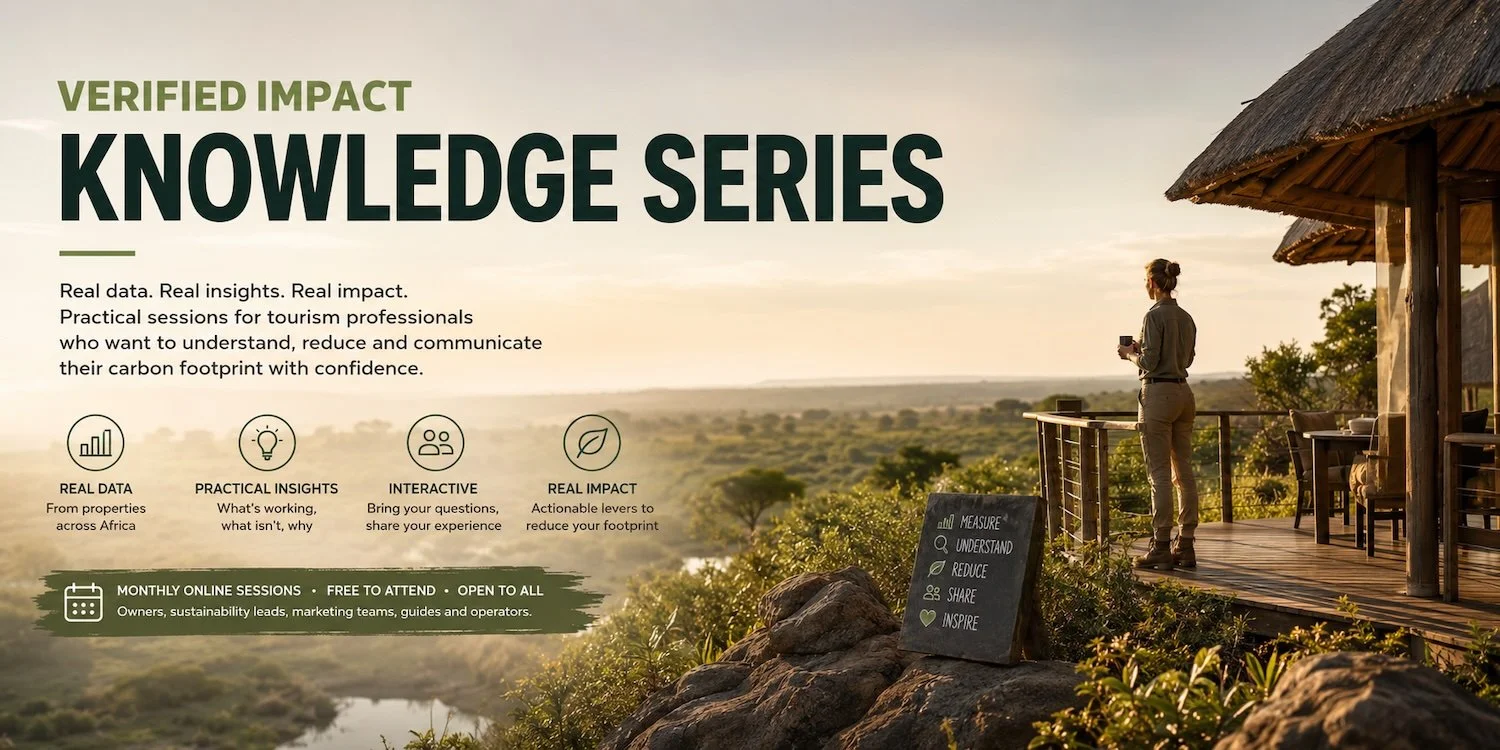
Knowledge Series
Climate Performance Knowledge Series
Practical online learning to help tourism teams understand carbon reporting, improve records, identify operational opportunities and communicate climate work confidently.
30 June 2026 · Duncan Pritchard
Read article