Two giraffes crossing open African grassland beneath a mountain escarpment

Eco Travel Foundation

Climate Performance Programme

Understand your footprint. Put it in context. Act on what matters.

A carbon footprint should help you run your property—not leave you with a number and a report nobody uses.

The Eco Travel Foundation’s Climate Performance Programme helps tourism properties measure carbon emissions, compare performance with relevant peers and identify practical improvements. Technical assessment and benchmarking are delivered by ETC Africa.

Our ambition is simple:

Reduce direct negative impact.
Increase local positive impact.

What your property gets

An assessment should leave you with a clearer picture, useful priorities and a team better equipped to act.

  • Your carbon baseline

    A property-level assessment showing emissions sources, the reporting boundary and where evidence or estimates support the results.

  • Performance in context

    Carbon intensity and relevant peer comparisons that help identify questions worth investigating.

  • Practical priorities

    An action roadmap focused on the operational changes and data improvements that matter most.

  • Support to understand the numbers

    Data support, programme resources and learning opportunities to help your team interpret and use the assessment.

  • Annual progress

    Reassessment to track changes in emissions, carbon intensity and data quality over time.

  • Clear communication

    An assessment summary and guidance on explaining the findings accurately within the assessed scope and reporting year.

For safari lodges, remote camps, coastal properties, guesthouses and hotels—with comparisons that recognise different operating circumstances.

What we need from you

A property contact who can help gather records, answer operational questions and work through the findings with us.

We work with the records your business already holds: fuel and electricity records, occupancy information and relevant operational data. You do not need a polished sustainability department or perfect spreadsheets to begin.

Where information is missing, the approach and limitations are documented and priorities for better evidence are agreed. The expectation is honesty, engagement and practical progress.

  1. 01Agree the property boundary and reporting year.
  2. 02Gather records and resolve material gaps.
  3. 03Review the assessment and action priorities.
  4. 04Reassess annually and track progress.

Where it began

From a funded pilot to an ongoing programme

The programme builds on a kimkim-funded climate action pilot, previously known as Verified Impact.

The pilot brought together a diverse group of tourism properties to establish carbon baselines, test contextual benchmarking and build the capability to use the results.

Its practical work included carbon assessments, GHG accounting training, one-to-one data support, reduction planning and shared learning. The Eco Travel Foundation now leads the programme’s next phase, with technical delivery by ETC Africa.

The original pilot targeted approximately 25 tourism properties and deliberately included a diverse range of operations: safari lodges, remote camps, coastal eco-lodges, boutique guesthouses, retreats and urban hotels.

This diversity matters.

Carbon performance only becomes useful when it is understood in context. A remote off-grid safari camp should not be judged in the same way as a city hotel.

Programme progress

Building the foundations

Carbon measurement was new territory for many participating businesses. The programme therefore had to do more than calculate footprints. It had to help people understand environmental data, find it inside their businesses and learn how to use it.

Programme progress indicators · May–July 2026 Q2 reporting period

23Active propertiesin the Q2 cohort
111 hoursDirect structured engagementQ1–Q2
27One-to-one data mentoring sessionsduring Q2
13Baselines complete or draft sentby the end of Q2
50+Properties representedin the wider tourism carbon benchmark database

Capacity building

The number isn't the end product.
Capability is.

For most participating properties, structured carbon accounting was new territory.

Carbon reporting only becomes useful when people can understand and act on it.

The pilot supported property champions through onboarding, carbon accounting training, data collection, emissions-factor interpretation and one-to-one mentoring. The ongoing programme builds on that approach: helping teams understand what drives their footprint and where they can make practical changes.

  1. Understand
  2. Measure
  3. Interpret
  4. Act
  5. Repeat
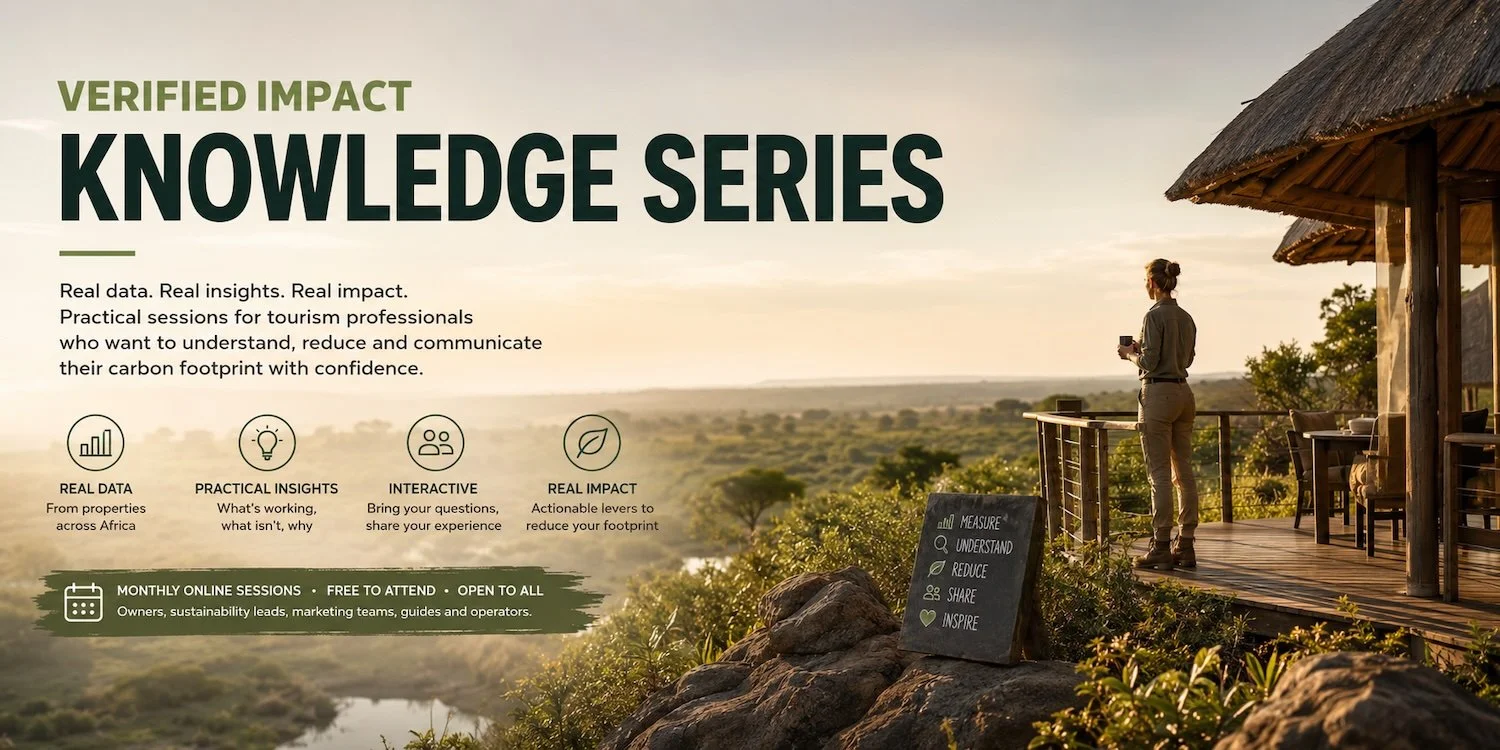
Climate Performance Knowledge Series graphic overlooking an African river valley

Climate Performance Knowledge Series

The programme's Knowledge Series extends learning beyond individual property champions to the people making operational and communication decisions across tourism businesses.

Topics include carbon literacy, better environmental data, lower-carbon operations, communicating climate action and understanding what travellers and agents increasingly expect.

Why context matters

One property tells us something. Fifty start to tell us something about an industry.

A carbon footprint becomes much more useful when there is something meaningful to compare it with.

Alongside participating property assessments, the programme has been developing a multi-property benchmark database covering more than 50 tourism operations.

The dataset includes measured carbon performance across safari lodges, eco-camps, beach lodges, boutique guesthouses and urban hotels operating in different Southern African conditions.

This allows us to begin asking better questions.

  • Why does one comparable lodge use significantly less diesel per guest night?
  • How much difference does renewable energy actually make?
  • What does good LPG performance look like for similar operations?
  • How does occupancy affect environmental intensity?
  • Where are the biggest practical opportunities to improve?

A benchmark gap prompts investigation. It does not prove inefficiency by itself. Operating context matters.

The mechanism

From measurement to action

The long-term value of environmental measurement is what happens next.

  1. Measure

    Build a carbon baseline from operational records, with estimates and limitations explained.

  2. Benchmark

    Compare carbon performance with relevant peers and operating contexts.

  3. Reduce

    Identify practical opportunities to reduce operational emissions.

  4. Contribute

    Explore opportunities for tourism activity to support nature and communities.

  5. Invest locally / restore

    Connect local partnerships and resources with conservation, community and restoration initiatives.

  6. Report

    Explain what was measured and what changed, and report local contributions separately.

Local contributions do not cancel operational emissions or guest flight emissions. Carbon measurement and reduction remain a responsibility in their own right. Conservation and community contributions sit alongside that work and are reported separately.

See how the programme works

Visible evidence

The assessment summary makes carbon performance visible

Three complementary views help explain the findings without reducing a property to a single score.

  • Data quality

    Can we trust the picture?

    How well the reported footprint is supported by records, evidence and documented estimates.

  • Benchmark

    How do we compare?

    Carbon performance against relevant peers, with operating context and comparison limitations explained.

  • Trajectory

    Are we improving?

    Changes over time, with the first assessment establishing a baseline.

Together, these help a property understand its findings, prioritise improvements and communicate the assessment accurately.

Eco Travel Foundation

Carbon assessment

2025 / 26

Rhino Sands

KwaZulu-Natal, South Africa
Safari Lodge

Measured. Benchmarked. Tracked.

Data quality

High

94% of emissions evidenced

Benchmark

Strong

18% below peer median (African lodges)

Trajectory

Baseline established

2025/26 reference year

21.98

kg CO₂e
per guest night

Assessed by

ETC Africa

This is an assessment, not a certification. Results apply to FY2025–2026.

About the assessment

A certification pathway in development

Assessment now. Formal certification is the next step being developed.

Properties can proceed with carbon assessment and practical improvement support while the Eco Travel Foundation develops a formal certification pathway.

The proposed pathway would recognise conformity with published requirements for credible carbon measurement, disclosure, benchmarking and annual performance management within a stated assessment boundary.

It would introduce independent checks and a defined certification decision process. Technical assessment by ETC Africa and independent certification review are distinct roles.

The pathway remains subject to reconciliation of the draft documents, independent review, testing and approval. Certification is not currently offered.

  1. Member

    Participation in the Foundation or programme. Membership alone does not establish that an assessment has been completed.

  2. Assessed

    A completed carbon assessment for a stated property boundary and reporting year.

  3. Certified — future pathway

    A proposed status requiring conformity with the final scheme requirements and independent checks. Not currently available.

An assessment or future certification would not, by itself, establish that a property is low-carbon, carbon-neutral or sustainable overall.

Led by the Eco Travel Foundation

A pilot designed to outlive the pilot.

kimkim’s funding helped test the model and establish the first cohort. The Eco Travel Foundation leads the next phase: continuing assessment, benchmarking and shared learning while developing the programme’s longer-term requirements and certification pathway.

  1. kimkim-funded pilot
  2. Measure · benchmark · improve
  3. Eco Travel Foundation
  4. Ongoing participation & learning

Partnership

Built through partnership

The Climate Performance Programme brings together technical expertise, tourism networks, conservation experience and catalytic funding.

  • ETC Africa — environment, tourism, carbon

    ETC Africa

    Technical Assessment & Benchmarking Partner

    Carbon measurement, evidence review, benchmarking and practical carbon performance analysis supporting the Climate Performance Programme.

    Explore ETC Africa(opens in a new tab)
  • The Eco-Travel Boutique — Travel Better

    The Eco Travel Boutique

    Founding Project Partner

    Founding tourism industry partner supporting pilot development, implementation and connections with participating properties.

    Visit Eco Travel Boutique(opens in a new tab)
  • kimkim

    kimkim

    Founding Funding Partner

    Catalytic funding supported the pilot programme and helped participating properties establish their carbon baselines.

    Visit kimkim(opens in a new tab)
  • Wilderness Leadership School

    Wilderness Leadership School

    Conservation & Impact Partner

    Connecting the initiative with conservation, wilderness leadership, environmental learning and tourism’s wider contribution to nature and communities.

    Visit Wilderness Leadership School(opens in a new tab)

The bigger vision

We started by measuring properties. We're building a way for an industry to learn.

  1. Property

    Understand your carbon footprint.

  2. Peers

    Compare performance in context.

  3. Industry

    Build useful tourism benchmarks.

  4. Traveller

    See the evidence behind the story.

  5. Place

    Support transparent local action.

The programme turns carbon information into practical decisions, clearer communication and shared learning. Alongside it, the Eco Travel Foundation helps tourism explore how to leave more value with the places and communities on which it depends.